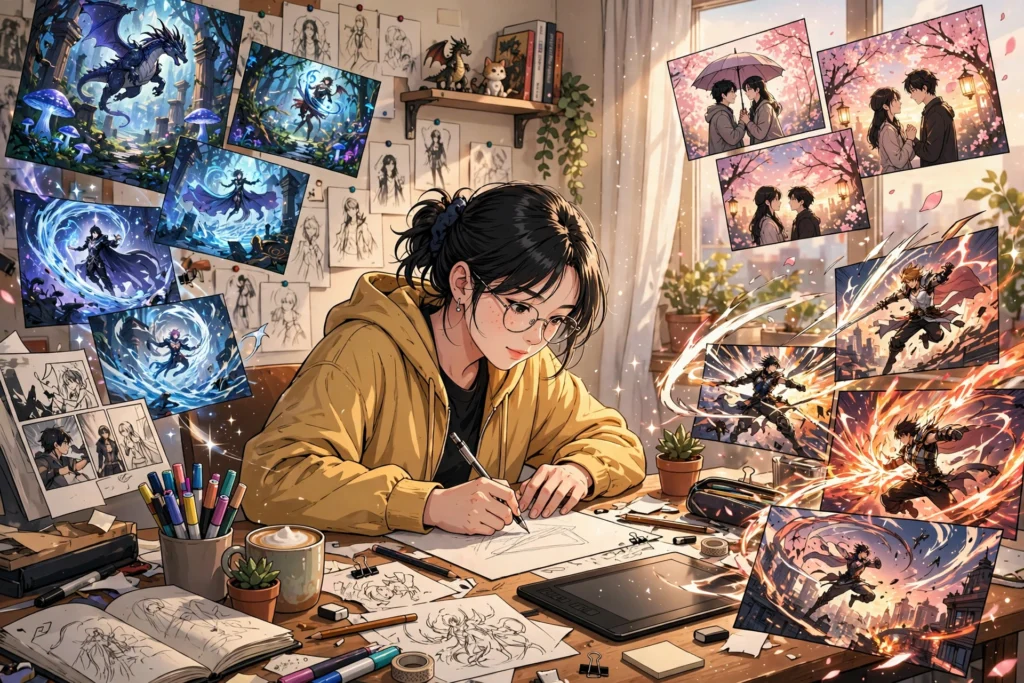
If you spend any time in anime or comic circles, you have probably heard the word manhwa thrown around. Solo Leveling became a global anime phenomenon. Tower of God and The God of High School turned into hit animated series. True Beauty charmed millions of K-drama fans. So what exactly is manhwa — and why is everyone suddenly reading it?
This guide answers the question “what is manhwa” from every angle: where Korean comics come from, how they differ from Japanese manga and Chinese manhua, which genres and titles define the medium, and exactly how to start reading. By the end, you will know whether manhwa is your next obsession.
The Simple Definition
Manhwa (만화) is the Korean word for comics and cartoons. Outside of Korea, the term specifically refers to Korean comics — stories created by Korean writers and artists, originally published in Korea, and increasingly read by a global audience.
The creator of a manhwa is called a manhwaga. You can find a solid overview of manhwa’s history and characteristics on Wikipedia if you want the academic deep dive, but here is the practical version: if manga is Japan’s comic tradition, manhwa is Korea’s — with its own formats, art styles, and storytelling flavor.
A Brief History of Manhwa
Korean comics have a much longer history than most international fans realize:
- Early 1900s: Cartoon-style illustrations first appear in Korean newspapers, used for satire and social commentary during a turbulent political era.
- 1940s–1950s: After Korean independence and through the Korean War, comics become a popular morale-boosting medium. Rental comic shops (manhwabang) let readers pay a small fee to sit and read — an early version of the comic café.
- 1960s–1980s: Manhwa diversifies into romance, humor, and action genres, but heavy government censorship and a distribution monopoly slow the industry down.
- 1990s: Print manhwa magazines boom, producing beloved series and the first wave of manhwa adapted into TV dramas.
- Early 2000s: The internet changes everything. Creators move online, and the webtoon — a comic designed to be scrolled vertically on a screen — is born. Platforms like Naver Webtoon (now WEBTOON) launch, and Korean comics start reaching readers worldwide.
- 2010s–today: The global explosion. English translations, official apps, and anime adaptations turn manhwa from a niche interest into a mainstream entertainment powerhouse.
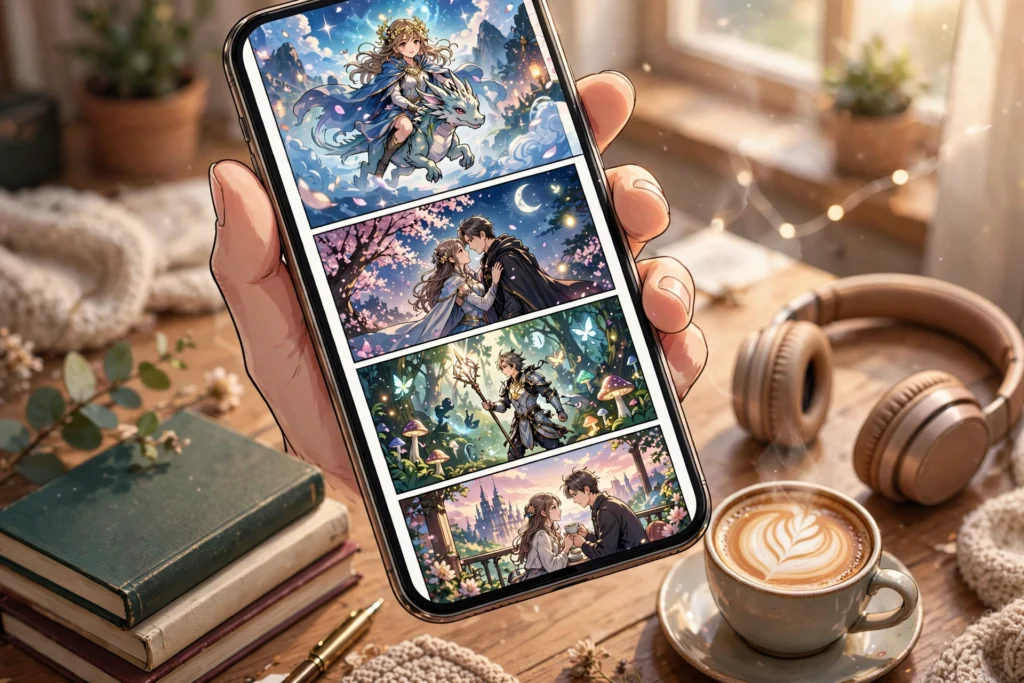
That last shift is the key to understanding modern manhwa: most of what international readers call “manhwa” today is actually webtoon-format comics — full-color, vertically scrolling, and designed for smartphones.
Manhwa vs Manga vs Manhua: What’s the Difference?
New readers constantly mix these three up. They are linguistic cousins — all three words essentially mean “comics” in Korean, Japanese, and Chinese respectively — but the formats are distinct:
1. Reading Direction
Manga traditionally reads right to left, following Japanese print conventions. Manhwa reads left to right, just like English books. That alone makes manhwa more immediately approachable for Western readers — no relearning how to move your eyes across the page.
2. Full Color vs Black and White
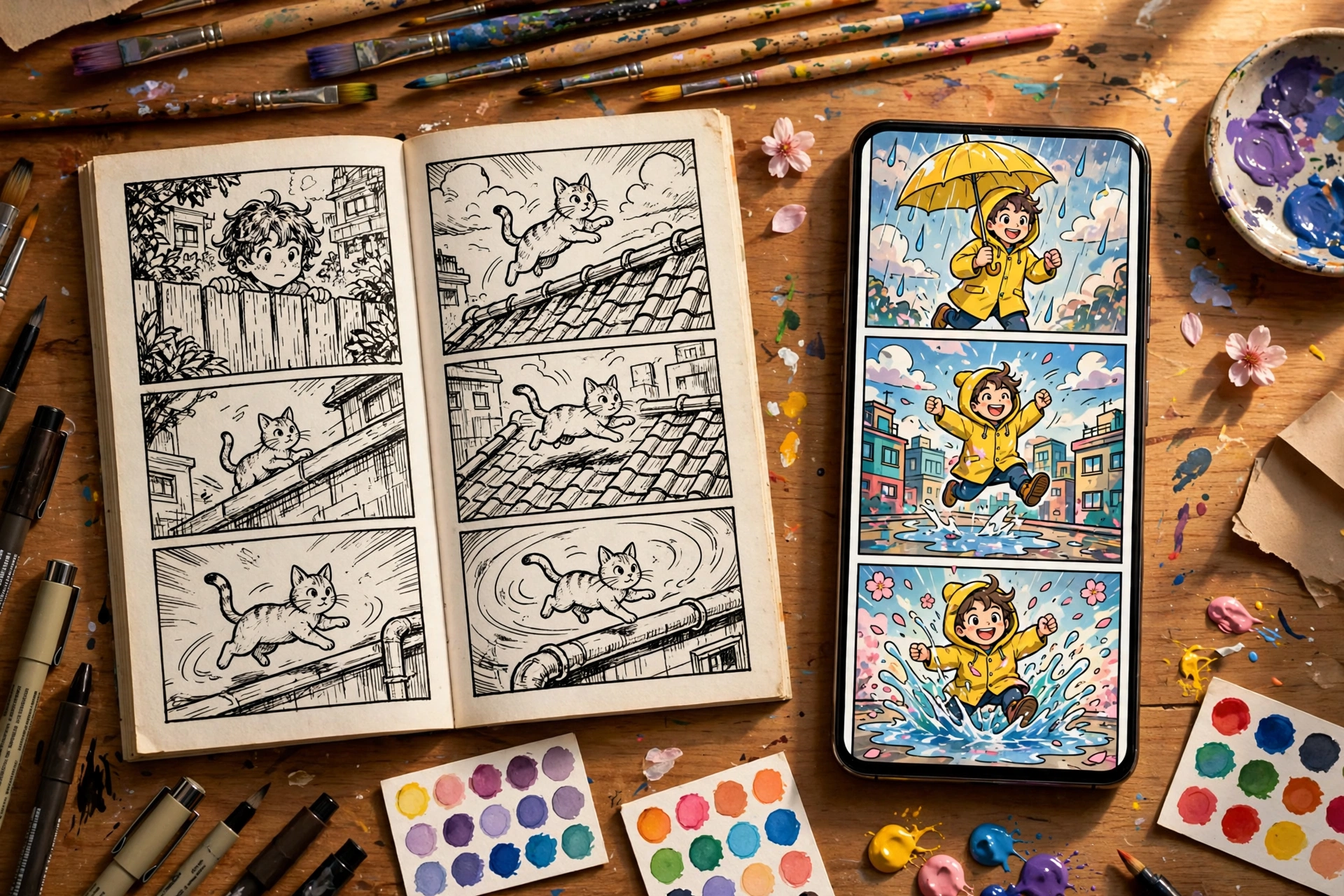
Print manga is famously black and white. Webtoon-format manhwa, by contrast, is almost always in full color. The vivid palettes are a huge part of manhwa’s appeal — glowing skill effects in action series, soft pastel tones in romance, and dramatic lighting that would be impossible in monochrome.
3. Vertical Scroll vs Page by Page
This is the biggest practical difference. Traditional manga is built for page turns. Modern manhwa is built for the infinite scroll — one long vertical strip you read by swiping down on your phone. Creators use the scroll itself as a storytelling tool: a long blank gap before a reveal, a sudden tall panel for a dramatic entrance, pacing controlled by your thumb.
4. Art Style
Manhwa characters often have realistically proportioned bodies with stylized, beautiful faces, plus highly detailed clothing and backgrounds. The overall look tends toward polished, cinematic digital art — many series feel like storyboards for the anime adaptations they eventually become.
5. Storytelling Flavor
While manga spans every genre imaginable, modern manhwa has become famous for specific tropes: tower-climbing fantasy, hunter/rank systems, reincarnation and regression stories, overpowered protagonists, and high-society romance. The pacing is typically fast — webtoons compete for attention one weekly episode at a time, so hooks come early and cliffhangers come often.
What Is a Webtoon, Exactly?
“Webtoon” is a portmanteau of “web” and “cartoon,” coined in Korea in 2000. It refers to comics created specifically for digital, vertical-scroll reading. Think of it this way: all webtoons are a format of digital comics, and most modern manhwa are webtoons.
The format was revolutionary because it:
- Let anyone publish — amateur creators could post directly to platforms and build audiences without a print publisher.
- Fit the smartphone era perfectly — no zooming, no sideways scrolling, just swipe down.
- Made comics free to start — most platforms offer many episodes free, monetizing through early access or ad-free reading.
When international fans say “I’m reading a webtoon,” they almost always mean a Korean webtoon-format manhwa. The two terms overlap so heavily that they are used interchangeably — though technically, webtoon is the format and manhwa is the national origin.
The Most Popular Manhwa Genres
Manhwa covers every genre, but a few dominate the global charts:
Romance
The single biggest genre. Stories range from sweet high-school love to intense historical palace intrigue and “contract marriage” fantasies where a modern woman wakes up as the villainess of a novel. Titles like True Beauty and Business Proposal turned this genre into K-drama gold.
Fantasy and Action
The genre that conquered the world. Tower-climbing epics (Tower of God), hunter systems (Solo Leveling), murim martial-arts sagas, and dungeon-crawling adventures dominate this space. Expect RPG-like ranking systems, jaw-dropping power-ups, and full-color battle scenes that manga can only dream of.
Reincarnation and Regression
A uniquely beloved manhwa trope: the protagonist dies and wakes up in the past — or inside the body of a novel’s villainess — with full memories and a second chance. The strategic “I know the future” plotting makes these incredibly bingeable.
Thriller and Horror
From the apartment-complex monster apocalypse of Sweet Home to psychological school dramas like Lookism, manhwa does tension brilliantly. The vertical scroll format is perfect for jump-scare pacing.
Slice of Life and Drama
Quiet, beautifully illustrated stories about everyday life, food, family, and growing up. A great palate cleanser between fantasy epics.
BL (Boys’ Love) and GL (Girls’ Love)
Romance between male or female leads, respectively — a massive and passionate corner of the manhwa world with dedicated platforms and enormous fandoms.
Famous Manhwa Titles You Should Know
If you are wondering where the hype comes from, start with these landmark series:
- Solo Leveling — the hunter-system action epic that became a global anime hit. The definitive “weak to overpowered” power fantasy.
- Tower of God — a sprawling mystery-fantasy about climbing a mysterious tower where every floor is a new world. One of the longest-running and most influential webtoons ever.
- The God of High School — a martial-arts tournament that escalates into gods-vs-mortals cosmic battles. Pure adrenaline.
- True Beauty — a makeup-and-self-image romance that became a K-drama phenomenon and introduced millions to manhwa.
- Lookism — a bullied teen wakes up in a second, perfect body and lives a double life. Sharp social commentary wrapped in a thriller.
- Noblesse — a noble vampire awakens in the modern world. A classic that helped define early webtoon action.
- Sweet Home — apartment residents vs. monsters born from human desire. Adapted into a hit Netflix series.
- Lore Olympus — a modern retelling of Hades and Persephone that won an Eisner Award and proved webtoons belong in the comics canon.
How to Start Reading Manhwa: A Beginner’s Roadmap
Ready to dive in? Follow these steps:
- Pick your genre first. Love romance? Start with True Beauty or Business Proposal. Crave action? Solo Leveling or Tower of God. Match the genre to your taste and you will be hooked by chapter three.
- Read on official platforms. Legal apps offer the best translations, support the creators, and are mostly free to start. Our companion guide to where to read manhwa online breaks down the five best legal platforms.
- Try the “3-episode rule.” Webtoons are designed to hook fast. Give any series three episodes — if you are not curious about episode four, move on. There are thousands of series waiting.
- Use the apps, not random sites. Official apps have offline downloads, bookmarks, and notifications for new episodes. They are also safe — no malware-riddled pop-ups.
- Join the community. Comment sections on official platforms, Reddit communities, and fan Discords are half the fun. Just watch out for spoilers.
Frequently Asked Questions
Is manhwa the same as manga?
No. Manhwa is Korean comics; manga is Japanese comics. The key practical differences: manhwa reads left to right, is usually in full color, and is designed for vertical scrolling on phones, while traditional manga reads right to left and is typically black and white.
What does “manhwaga” mean?
Manhwaga (만화가) is the Korean word for a comic artist or author — the equivalent of “mangaka” in Japanese. Many popular webtoons are created by a writer-artist duo rather than a single person.
Are webtoons and manhwa the same thing?
Not exactly, but they overlap almost completely in practice. “Manhwa” means Korean comics; “webtoon” is the vertical-scroll digital format. The vast majority of manhwa read internationally today is published in webtoon format, so the terms are used interchangeably.
Is manhwa appropriate for kids?
It depends on the series. Many webtoons are all-ages, but platforms also host mature-rated romance, horror, and action series. Official apps include age ratings and content warnings — check them before handing your phone to a younger reader.
Conclusion
So, what is manhwa? It is Korea’s vibrant comic tradition — full-color, vertically scrolling, phone-first stories that have conquered global entertainment, from anime adaptations to Netflix dramas. Whether you want heart-pounding action, swoon-worthy romance, or mind-bending thrillers, there is a manhwa waiting with your name on it.
The best part: getting started costs nothing. Pick a genre, grab an official app, and give a series three episodes. Once you feel the pull of that infinite scroll, there is no going back. Happy reading!
1 thought on “What Is Manhwa? The Complete Beginner’s Guide to Korean Comics”